
Is power consumption the best metric for selecting a server?
Multiple times per day, I end up browsing reddit and running into…. MANY posts from people trying to hit the lowest possible power draw, no matter what the hardware costs to get there.
Info
This post was originally published in 2022, and has been adopted to this static-site from wordpress. The old post had a calculator baked in as a WordPress plugin. That didn't survive the move - so I rebuilt it natively, and now the calculators below actually run right here in your browser. Change any number and the results update.
I've written about this before, but this time I wanted to put all of the actual math front and center, so you can plug in your own numbers and make your own call instead of taking my word for it.
Note - affiliate advertising links are used in this article.
ROI Calculator
Here's the whole thing in one place. It works out how much energy each option costs you per year, how much you'd save going with the more efficient hardware, and - the part that actually matters - how many years it takes to pay back the extra money you spent to get there.
It's pre-filled with my numbers: on the left, my Dell R720XD at ~300W. On the right, a rough build cost for a newer, more efficient server that could actually handle my workloads. (Realistically that number would be higher - I regularly use 70-100GB of RAM, and RAM isn't cheap.)
Examples
Example #1 - My R720XD versus a newer server
The calculator above is pre-filled with this exact scenario. My R720XD pulls ~300W. A more efficient replacement might pull half that, but costs me ~$1,000 more to build.
At my (fairly cheap) local rate, the new box saves me around $100/year on power.
Results? Used enterprise server wins, by far.
With those numbers, I don't break even for roughly a decade. Yes - my electric bill would be ~$100/year cheaper. But I still wouldn't get my money back for a full 10 years.
Hardware has a finite lifecycle, so anything with an ROI north of ~7 years is, to me, just not worth the extra effort or money.
Example #2 - My R720XD versus a newer server, in Germany
Exactly the same comparison, with one change: instead of my local rate, I'll use a rough national average for Germany, which at the time was around 32c/kWh.
Same hardware, just a different power cost - watch what happens to the break-even:
Results? Much more expensive, but the efficient option wins by a large margin.
Nothing changed except the price per kWh - and now the efficient option pays for itself in a couple of years instead of ten. That's the whole point: your power cost is the biggest lever here, not the hardware.
Example #3 - Used corporate SFF vs Intel NUC
For this one I'll compare a used HP Z240 against a brand-new Intel NUC. I picked this on purpose, because I see a LOT of people reaching for a NUC instead of a used piece of enterprise/office gear.
HP Z240
Ebay: HP Z240 - 8GB DDR4 RAM - i5-6500eBay affiliate linkThis is an eBay Partner Network affiliate link. It costs you nothing extra, and any purchase made through it helps support this site.
At the time of writing, one of these shipped ran about $120-140 USD.
Intel NUC
Amazon: NUC7PJYHN2 - Quad-Core Pentium Silver J5005, 8GB DDR4 RAMAmazon affiliate linkAs an Amazon Associate I earn from qualifying purchases at no additional cost to you; using this link helps support the site.
Cost at the time of writing was ~$400.
Hardware comparison
Right off the bat, the older Z240's i5-6500 offers nearly double the performance of the “low power” Pentium in the NUC. Both have 8GB of DDR4. Ignore storage for now - both can take NVMe for basically the same price.
Power consumption
I actually have multiple HP Z240 desktops around the house. One runs my OPNsense firewall, another is a gaming PC in the living room.
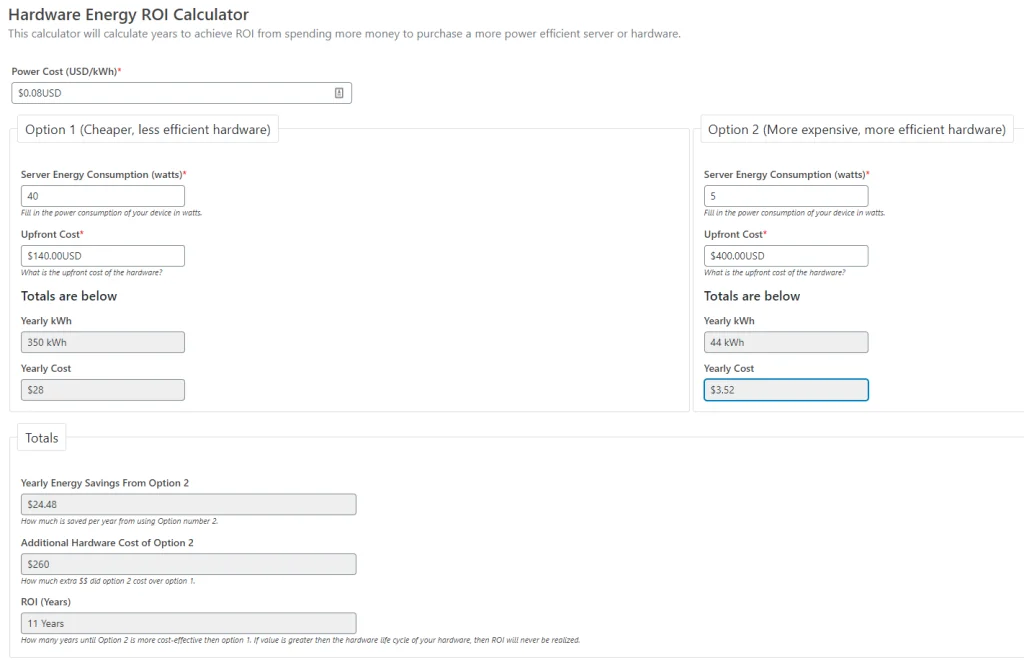
I've measured my firewall's draw under normal load at 25W - a plain Z240 with an i5-6500, 8GB of RAM, NVMe, and a 10G NIC. For worst-case, let's pretend it pulls 40W on average, which is well above what it actually uses.
I don't have a NUC on hand. But its documentation lists < 15W under idle/sleep. Let's be generous and assume 5W typical - almost certainly below what it really pulls.
So let's stack the deck in the NUC's favor and still run the numbers:
Results? SFF wins.
Remember, I nearly doubled my actual Z240 draw, gave the NUC an unrealistically low 5W, and speced out one of the cheapest NUCs you can get - one whose CPU offers half the performance of the older i5-6500 released back in Q3 2015.
Even with the deck stacked, you're paying a big premium up front to save a few bucks a year. The NUC effectively never reaches ROI… because you're going to throw it in the garbage in a few months anyway, thanks to that underpowered processor.
Conclusion
Do the math.
Don't like doing math? Fine - that's what the calculators above are for. Plug in your numbers. If the ROI comes out >= 7 years, go with Option 1. If it's < 7 years, go with Option 2.
Obviously I have relatively cheap electricity (and solar panels are going up soon on top of that). What works for me won't work for someone in a high-cost area like Germany, where the average cost/kWh is roughly 4x what I pay.
So - in conclusion…. DO YOUR MATH!!!
E-Bay Affiliate Links Used
This post DOES include EBay affiliate links. If you found this content useful, please consider buying the products displayed using the provided links.
You will pay the same amount as normal, however, it does provide a small benefit to me. This benefit is usually used to purchase other products and hardware for which I can review / blog about.
I do not display advertisements on this site. As such, the only compensation from this service, comes from affiliate links. I do not ask for, or even accept donations.
Amazon Affiliate Links Used
This post DOES include Amazon affiliate links. If you found this content useful, please consider buying the products displayed using the provided links.
You will pay the same amount as normal, however, it does provide a small benefit to me. This benefit is usually used to purchase other products and hardware for which I can review / blog about.
I do not display advertisements on this site. As such, the only compensation from this service, comes from affiliate links. I do not ask for, or even accept donations.